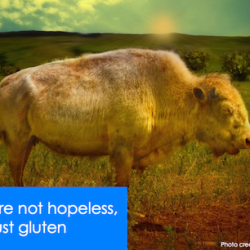
Video credit: PBS on YouTube
What happens when you spend years being told that your strange collection of symptoms is simply something you have to live with—and then you discover that changing what you eat seems to make an enormous difference?
That is the heart of The Great White Buffalo, a personal story originally published by GF Magazine in 2018. Written by Dave Barber, the article looks back on years of unexplained skin problems, frustration, travel, failed attempts at going gluten-free and, eventually, a major lifestyle change.
His story is emotional, funny in places, and very personal. It also raises a question that still gets plenty of attention in 2026:
Can gluten cause serious symptoms even when you do not have celiac disease?
The modern answer is more nuanced than the original article suggested. Dave’s experience remains his experience, while current medical thinking recognizes non-celiac gluten sensitivity as a real area of clinical concern without treating every gluten-related symptom as proof of a single disease.

What Is The Great White Buffalo About?
At its core, Dave Barber’s article is about an exhausting search for answers.
He describes being in his mid-twenties, drinking beer, eating a fairly poor diet and dealing with recurring skin rashes. The first major clue was eczema, followed by years of unpredictable symptoms affecting different parts of his body.
According to his account, prescription medication could control the rash, but it did not explain why it kept happening.
That difference is huge.
Imagine your car dashboard showing a warning light. Someone puts tape over it and says, “There you go. Fixed.” The light is gone, but the underlying problem is still there.
That is essentially how Dave felt about his symptoms.
He wondered whether food or gluten might be involved, but says those ideas were repeatedly dismissed during earlier medical visits.
The frustration eventually became impossible to ignore.
Dave Barber’s Seven-Year Battle With Unexplained Symptoms
In the original story, Dave describes about seven years of skin problems that came and went.
The symptoms appeared on his face, arms, legs, neck and back. There were good periods and bad periods, but the overall pattern remained unpredictable.
He says lotions and non-prescription approaches did not solve the problem, while medication could suppress the reaction.
The bigger problem, however, was uncertainty.
He wanted to know what his body was reacting to.
That is a familiar feeling for anyone who has experienced a long period of unexplained symptoms. The hardest part is often not the discomfort itself. It is not knowing what to do next.
That theme remains one of the strongest parts of the story.
Our 5 Tips for a Gluten-Free Newbie explores the practical side of adjusting to a gluten-free lifestyle once the decision has actually been made.
The Breaking Point: A Hotel Bathroom in 2010

One of the most vivid moments in Dave’s story happens during his years as a traveling salesman.
He describes flying from city to city, accumulating hotel points and surviving on what he calls a horrible diet. Then, about 18 months before writing the article, his symptoms became so severe that he canceled his trip and flew home.
He says he looked at himself in a hotel bathroom and barely recognized what he saw: a swollen face, widespread rash and bloodshot eyes.
That moment became the turning point.
Sometimes people change because they want to feel healthier.
Sometimes they change because they have run out of options.
Dave’s story clearly falls into the second category.
The Elimination Diet That Changed Everything for Dave
After returning home, Dave says he met a new naturopath who suggested an elimination diet and suspected gluten might be involved.
He was initially skeptical.
In the article, he describes the idea of going gluten-free as difficult, complicated and somewhat ridiculous.
Then he tried it.
According to his account, the symptoms improved enough for him to believe gluten was playing a role. He later underwent celiac blood work and an endoscopy.
The tests did not show celiac disease, but Dave describes being told that his condition fit what was then commonly called non-celiac gluten intolerance.
Today, the preferred term is usually non-celiac gluten sensitivity (NCGS), and the diagnosis is more complicated than simply getting better after removing bread from your diet.
Current medical practice generally requires ruling out celiac disease and wheat allergy and carefully evaluating whether symptoms are actually linked to gluten or wheat exposure.
The National Institute of Diabetes and Digestive and Kidney Diseases provides current information on celiac disease, diagnosis and treatment.
Dave Says He Was “The Great White Buffalo” of Gluten Disease
This is where the memorable title comes from.
Dave describes himself as the “mysterious Great White Buffalo” of gluten-related disease because he tested negative for celiac disease while believing strongly that gluten was causing problems for him.
The phrase is catchy, but the medical situation deserves a little more care than the original wording gives it.
Non-celiac gluten sensitivity is not simply “celiac disease without the test result.”
There is no single blood test that proves NCGS, and symptoms can overlap with irritable bowel syndrome and other digestive or inflammatory conditions.
That does not make someone’s symptoms imaginary.
It simply means the diagnosis is not as straightforward as “I stopped eating gluten and felt better, therefore gluten was definitely the cause.”
That distinction matters even more today because social media has made elimination diets dramatically more popular.
Going Gluten-Free Was Not Easy the First Time

One of the most relatable parts of Dave’s story is that he did not immediately become an expert at gluten-free living.
He says he tried and failed repeatedly before finally committing to the lifestyle.
Anyone who has attempted a major diet change knows how that goes.
The first week is often full of enthusiasm.
By the third week, you’re standing in front of the refrigerator asking why every sauce, cracker, snack and frozen meal suddenly seems to contain an ingredient with seventeen syllables.
Dave eventually committed fully and says he had been gluten-free since May 2012.
That long-term commitment was not just about avoiding obvious foods such as bread and pasta. It involved changing how he traveled, shopped and prepared meals.
Our guide to gluten-free oats shows just how quickly food choices can become more complicated once cross-contact and processing enter the conversation.
Why Traveling Made Gluten-Free Living Especially Difficult
Dave’s job as a traveling salesman was almost the perfect storm for someone trying to control an unexplained food-related condition.
Hotels.
Airports.
Restaurants.
Business dinners.
Meals grabbed between meetings.
When someone cooks every meal at home, controlling ingredients is relatively easy. When someone eats in different cities every few days, the challenge becomes much bigger.
That is why modern gluten-free advice often places so much emphasis on planning.
Research the restaurant.
Ask about preparation.
Carry a backup snack.
Know what cross-contact looks like.
Our gluten-free Bangkok street food guide is an example of how destination-specific preparation can make travel less stressful.
The Big Lifestyle Change: Moving to Hawaii
Then Dave took the story in a completely different direction.
He says he left his six-figure job and moved to Hawaii, where he cooked every meal himself and focused on whole foods.
That is not exactly a small lifestyle adjustment.
Most people respond to a bad Tuesday by ordering pizza.
Dave responded to years of unexplained symptoms by moving to an island and rebuilding his diet.
According to his account, the goal was to give his body several months without accidental gluten exposure and see what happened.
He says the result was encouraging. He still had bad days, but he believed he was gradually getting better and felt physically stronger.
The story also mentions a thyroid condition that his naturopath believed was consistent with Hashimoto’s disease.
That last point should be treated carefully. A personal account cannot establish a diagnosis, and thyroid disease should be evaluated by a qualified medical professional.
What Did Dave Actually Improve?

According to Dave, the changes were significant enough that he described the journey as “working.”
He reported improvement in his skin and overall well-being and said he felt as though his old self was gradually returning.
That is the emotional center of the article.
After years of thinking the situation was permanent, he finally felt hopeful.
For people dealing with unexplained symptoms, hope can be powerful.
But there is another important lesson for today’s readers: an improvement is information, not necessarily a diagnosis.
If someone feels better after removing gluten, that’s worth discussing with a doctor. It doesn’t automatically prove that gluten was the only cause.
Celiac Disease vs. Non-Celiac Gluten Sensitivity
This distinction is central to understanding Dave’s story in 2026.
Celiac Disease
Celiac disease is an autoimmune disorder in which eating gluten triggers an immune reaction that damages the small intestine.
Diagnosis usually involves blood testing and, when appropriate, an intestinal biopsy.
A strict gluten-free diet is the standard treatment after diagnosis.
Non-Celiac Gluten Sensitivity
Non-celiac gluten sensitivity refers to people who experience symptoms associated with consuming gluten or wheat but do not meet diagnostic criteria for celiac disease or wheat allergy.
The challenge is that there is no single laboratory test that definitively confirms NCGS.
That means the diagnosis requires careful medical evaluation rather than a social-media checklist.
For more practical food-label information, read our maltodextrin and gluten-free guide.
Why Dave’s Story Still Resonates in 2026
Almost a decade later, the article remains compelling because the underlying emotion has not changed.
People want to understand why they feel unwell.
They want their concerns taken seriously.
And when conventional answers don’t explain their experience, they often begin searching elsewhere.
That part of the story is deeply human.
The lesson, however, should not be “ignore doctors.” It should be “keep asking good questions and seek a proper evaluation when the answer isn’t clear.”
Modern medicine has learned a great deal about celiac disease, food allergies and gastrointestinal disorders since the original article was published.
At the same time, there are still areas where research continues.
The Real Meaning Behind “The Great White Buffalo”

The title is not just a clever phrase.
The white buffalo has a much older cultural meaning in North American Indigenous traditions, including among the Lakota and other Plains peoples.
The Smithsonian National Museum of the American Indian explains that the white buffalo calf holds special significance for many American Indian communities. The Lakota oral tradition includes the story of the White Buffalo Calf Woman, who is associated with the sacred pipe and important teachings.
The story has several versions, and it should be approached respectfully as a living cultural tradition rather than a simple legend pasted onto a modern health article.
You can read the Smithsonian’s educational material on the White Buffalo Calf Woman and bison traditions.
The White Buffalo Became a Modern Symbol Too
In recent years, white buffalo have also attracted enormous public attention because actual white bison are extremely rare.
In June 2024, Yellowstone National Park confirmed that a white bison calf had been born in Lamar Valley. Park officials said the calf appeared to be leucistic rather than albino, meaning it retained pigmentation in its eyes and hooves.
Chief Arvol Looking Horse, a Lakota spiritual leader and keeper of the Sacred White Buffalo Calf Pipe and Bundle, described the birth as both a blessing and a warning.
That event brought the symbolism of the white buffalo into mainstream news around the world.
It also created a strange modern connection with Dave Barber’s story: a title that originally described one man’s search for answers now sits against a much larger cultural conversation about health, nature and meaning.
What We Can Learn From Dave Barber’s Gluten-Free Journey
There are several useful lessons in the story—without treating the story as medical proof.
1. Keep Track of Patterns
If symptoms repeatedly appear after certain foods or in certain situations, write them down.
Memory is surprisingly unreliable, especially when you’re tired or unwell.
2. Get Tested Before Eliminating Gluten
If celiac disease is a possibility, discuss testing with a healthcare professional before removing gluten completely.
Starting a gluten-free diet first can make some diagnostic testing harder to interpret.
3. Don’t Confuse Improvement With Proof
Feeling better after changing your diet is important information, but it does not necessarily identify the exact cause.
4. Whole Foods Can Make Eating Simpler
One thing Dave emphasizes is the move toward whole foods and home cooking.
For anyone trying to reduce uncertainty around ingredients, that’s a very practical strategy.
Our gluten-free teriyaki sauce recipe is one simple example of making a common pantry sauce from scratch.
Gluten-Free Does Not Have to Mean Miserable
Dave’s story begins in a place of frustration, but it ends with optimism.
And that’s worth remembering.
A gluten-free lifestyle can initially feel restrictive. Then something funny happens.
You learn.
You find your reliable meals.
You discover restaurants that understand your needs.
You learn which labels deserve another look.
Eventually, reading “may contain” statements becomes almost as normal as checking the price.
Our mini gluten-free corn dog bites and Parmesan gluten-free chicken nuggets are good examples of how gluten-free cooking can still be fun.
When Should You Talk to a Doctor?
Persistent unexplained symptoms deserve medical attention, especially when they involve significant skin reactions, gastrointestinal problems, unexplained weight changes, neurological symptoms or ongoing fatigue.
Do not assume that gluten is the explanation before other possibilities have been considered.
And do not dismiss symptoms simply because an earlier doctor did not have an answer.
A second opinion can be reasonable when a problem is persistent or affecting your quality of life.
The goal is not to pick sides between “conventional medicine” and “alternative medicine.”
The goal is to find the right explanation and the safest treatment.
More Gluten-Free Resources From GF Magazine
If Dave Barber’s story has you thinking about your own diet, start with practical information rather than dramatic internet claims.
Our International Celiac Disease Symposium recap offers another look at celiac-related discussions.
The GF Magazine Podcast archive explores the social and everyday side of living gluten-free.
You can also read The Nitty Gritty on Oats before making changes to your breakfast routine.
The Great White Buffalo in 2026: What Is the Real Takeaway?
Dave Barber’s The Great White Buffalo is ultimately a story about persistence.
He spent years searching for an explanation, experimented with his diet, committed to a gluten-free lifestyle and reported feeling much better.
That personal experience deserves to be heard.
But the smartest way to read the article in 2026 is with two ideas in mind at the same time:
Personal experiences matter.
Personal experiences are not the same thing as medical evidence.
Today we know that celiac disease can be diagnosed with established testing, while non-celiac gluten sensitivity remains a more difficult condition to define and diagnose.
We also know that unexplained symptoms should not simply be ignored.
So perhaps the most useful message hidden inside this unusual story is this:
Pay attention to your body. Ask questions. Keep records. Get tested when appropriate. And don’t give up on finding a sensible explanation just because the first answer doesn’t fit.
Dave called himself a “Great White Buffalo” because he felt like an unusual case.
Maybe the better modern interpretation is simpler.
Sometimes finding the right path takes longer than we want.
But that doesn’t mean there isn’t one.
Frequently Asked Questions About The Great White Buffalo
What is The Great White Buffalo by GF Magazine?
The Great White Buffalo is a personal story by Dave Barber describing his years of unexplained symptoms, his eventual decision to try a gluten-free diet and the improvements he said he experienced afterward.
Who wrote The Great White Buffalo?
The article was written by Dave Barber and published by GF Magazine in July 2018.
Did Dave Barber have celiac disease?
According to his article, Dave underwent celiac blood testing and an endoscopy and said the results did not show celiac disease.
What did Dave believe was causing his symptoms?
Dave believed gluten was contributing to his health problems and reported improvement after eliminating gluten from his diet.
What is non-celiac gluten sensitivity?
Non-celiac gluten sensitivity describes symptoms associated with gluten or wheat exposure in people who do not meet diagnostic criteria for celiac disease or wheat allergy. There is no single accepted laboratory test that proves the condition.
Is non-celiac gluten sensitivity the same as celiac disease?
No. Celiac disease is an autoimmune condition with established diagnostic criteria and intestinal involvement. Non-celiac gluten sensitivity is a separate and more difficult-to-define condition.
Should I stop eating gluten if I think I have celiac disease?
Talk with a healthcare professional before eliminating gluten, because going gluten-free before diagnostic testing can affect some test results.
Can a gluten-free diet make you feel better even without celiac disease?
Some people report symptom improvement after removing gluten or wheat. However, improvement alone does not prove the cause, and other dietary or medical factors may also be involved.
Why is the white buffalo culturally important?
The white buffalo calf has special spiritual significance in several Native American traditions, including the Lakota. The White Buffalo Calf Woman story is an important part of Lakota oral tradition.
What happened with the white buffalo calf in Yellowstone?
Yellowstone National Park confirmed that a white bison calf was born in Lamar Valley on June 4, 2024. Park officials said it appeared to be leucistic rather than albino and acknowledged its cultural significance to American Indian communities.
Why is Dave’s story still popular?
It combines a personal health mystery, frustration with unexplained symptoms, a dramatic lifestyle change and an eventual sense of hope. Those themes continue to resonate with readers dealing with difficult-to-explain health problems.
Where can I find more GF Magazine gluten-free content?
Explore the GF Magazine homepage, the GF Magazine Podcast archive, and practical articles such as the maltodextrin gluten-free guide and gluten-free oats article.